Here are common plumbing terms explained in plain English, grouped by where you find them in a house. When a technician mentions a failed pressure reducing valve or a buried cleanout, this page tells you what that means. It is written for Cheyenne homeowners, though the words mean the same thing in any home.
How to use these plumbing terms
The short answer
Most plumbing words describe one of six things. The pipe material, a valve that controls water, the drain and sewer system, the water heater, the fixture you use, or a tool or method the technician uses. Find the group below, then the term.
Pipes and materials
| Term | What it means | Where you see it |
|---|---|---|
| PEX | Flexible plastic supply pipe, usually red, blue or white, joined with crimp or expansion fittings | Newer homes and many repairs |
| Copper | Rigid metal supply pipe joined with soldered or press fittings | Homes of almost every age |
| Galvanized steel | Steel pipe coated in zinc that rusts from the inside over the years | Older homes, often with low pressure |
| CPVC | Cream colored plastic supply pipe glued at the joints | Some homes and repairs |
| PVC | White plastic pipe used for drains, vents and sump lines | Drain lines and sump discharge |
| ABS | Black plastic pipe used for drains and vents | Drain lines in many homes |
| Cast iron | Heavy metal drain pipe that lasts a long time but can crack or rust through | Main stacks and older sewer lines |
| Clay tile | Short sections of fired clay pipe laid end to end | Older sewer lines, where roots often get in |
If your home still has galvanized supply pipe, repiping explains the options. The guide on why water pressure drops covers why old steel pipe slowly closes up.
Valves
| Term | What it does | Where it usually is |
|---|---|---|
| Main shut off valve | Closes the water to the whole house | Where the water line enters, near the meter |
| Gate valve | An older valve with a round handle that turns many times. It can seize with age | Older mains and water heaters |
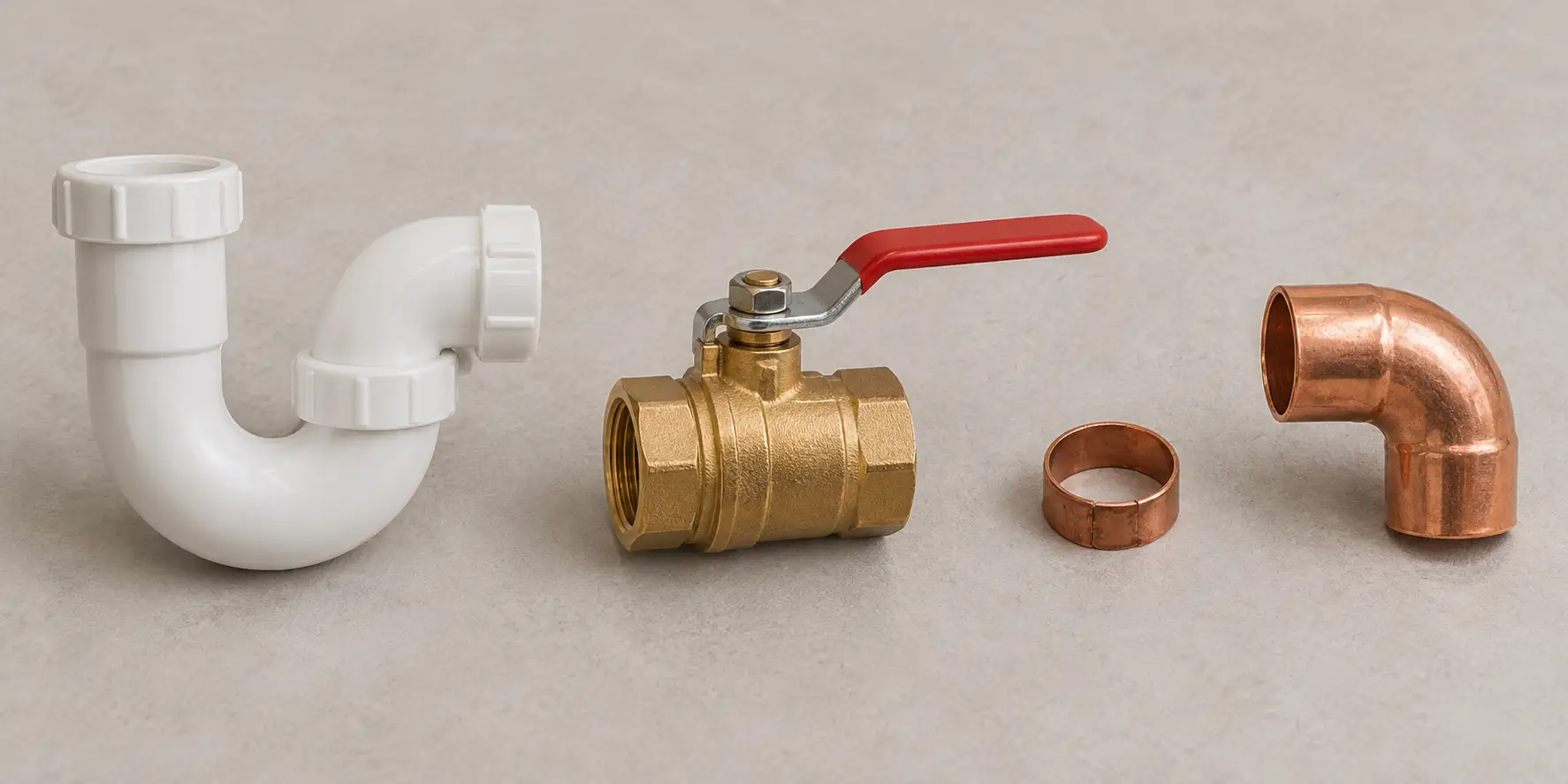
| Ball valve | A valve with a lever that closes in a quarter turn | Newer mains and branch lines |
| Stop valve or angle stop | A small valve that shuts water to one fixture | Under sinks and behind toilets |
| Curb stop | A valve at the property line, usually closed with a long key | In the yard or near the sidewalk |
| Pressure reducing valve | A bell shaped valve that lowers incoming water pressure | Just after the main shut off |
| Relief valve | Opens to release water if a water heater gets too hot or the pressure climbs too high | On the top or side of the water heater |
| Check valve | Lets water flow in only one direction | Sump pump lines and some supply lines |
| Backflow preventer | Keeps used water from being pulled back into the clean supply | Sprinkler systems and some mains |
The guide on shutting off your water shows how to close each type, which is worth knowing before a pipe bursts.
Drains and sewer
- Trap. The curved section under a sink or tub that holds a little water to block sewer gas. The one under a sink is often called a P trap.
- Vent stack. A pipe that runs up through the roof so drains get air and flow smoothly. A blocked vent causes gurgling and slow drains.
- Branch drain. A drain line serving one area, like a bathroom or kitchen, that joins the main line.
- Main sewer line. The single pipe that carries all waste out of the house toward the public sewer.
- Cleanout. A capped opening in the drain or sewer line that gives straight access for cleaning.
- Floor drain. The drain in a basement or utility room floor, usually the lowest opening in the house.
- Backwater valve. A one way flap in the main line that closes if sewage tries to flow back into the house.
- Belly. A low, sagging stretch of sewer pipe where water and waste collect.
- Root intrusion. Tree roots growing into cracks or joints in a sewer line.
See drain cleaning and sewer line repair for the work behind these terms, and sewer backup in the basement for what to do when the main line fails.
Water heaters
| Term | What it means | Where you find it |
|---|---|---|
| Anode rod | A metal rod that corrodes on purpose so the steel tank does not | Screwed into the top of the tank |
| Dip tube | A plastic tube that carries incoming cold water to the bottom of the tank | Inside, under the cold inlet |
| Thermocouple or flame sensor | A safety part that shuts off the gas if the pilot goes out | Beside the pilot on gas tanks |
| Pilot | A small flame that lights the main burner | Behind the window near the bottom of gas tanks |
| Heating element | A metal rod that heats water with electricity. Most electric tanks have two | Behind the cover plates on electric tanks |
| High limit reset | A red button that cuts power if the water gets too hot | Above the upper thermostat on electric tanks |
| Expansion tank | A small tank that absorbs the extra pressure as water heats | On the cold line near the heater |
| Sediment | Minerals and grit that settle on the bottom of the tank | You hear it as popping or rumbling |
| Tankless heater | A wall unit that heats water as it flows instead of storing it | Mounted on a wall with its own vent |
The guide on why a water heater stops working uses most of these words. Repairs are covered under water heater repair and tankless water heater repair.
Fixtures
- Flapper. The rubber seal at the bottom of a toilet tank that lifts to flush. A worn one makes the toilet run.
- Fill valve. The valve in the toilet tank that refills it after a flush, controlled by a float.
- Wax ring. The seal between the base of the toilet and the drain in the floor.
- Closet flange. The fitting in the floor that the toilet bolts down to.
- Aerator. The small screen at the tip of a faucet that mixes air into the stream.
- Cartridge. The part inside a single handle faucet or shower valve that controls flow and temperature.
- Supply line. The short flexible hose from a stop valve to a faucet or toilet.
- Escutcheon. The trim plate that covers the hole where a pipe or valve comes through the wall.
- Mixing valve. A shower valve that blends hot and cold water and guards against sudden temperature swings.
More on these parts in toilet repair, faucet and sink repair and shower and tub repair. When a toilet runs over, the guide on what to do when a toilet overflows puts the flapper and fill valve to use.
Tools and methods
| Term | What it is | Used for |
|---|---|---|
| Flange plunger | A plunger with a soft sleeve that seals a toilet drain | Toilet clogs |
| Drain auger or snake | A coiled steel cable turned into a drain to break up a clog | Sink, tub and main line clogs |
| Hydro jetting | High pressure water that scours the inside of a drain line | Grease, scale and roots |
| Camera inspection | A waterproof camera pushed into a sewer line to show its condition | Repeat clogs and backups |
| Pressure test | Filling a line and watching a gauge to find leaks | After repairs and during leak searches |
| Crimp or expansion fitting | Ways of joining PEX pipe with rings and fittings | PEX repairs |
| Soldering | Joining copper pipe with heat and solder | Copper repairs |
| Trenchless repair | Fixing a sewer line through small access pits instead of one long trench | Sewer lines under yards and driveways |
You can read more about hydro jetting, sewer camera inspection and leak detection on their own pages.
Using these words when you call
You do not need the right word to get help. Describe what you see, where it is and what changed. "Water comes up the basement floor drain when the washer runs" tells the technician as much as any trade term.
- Which fixture or room the problem is in
- Whether the house has a gas or an electric water heater
- What pipe you can see, by color if you are not sure of the name
- Whether you have already closed a valve, and which one
The emergency checklist lists what else to note down while you wait. And if you hear a word on the visit that is not on this page, ask. The technician should be able to explain it in plain terms before any work starts.
Questions people in Cheyenne ask
What is the difference between a gate valve and a ball valve?
A gate valve has a round handle that turns many times and lowers a metal gate inside. Old ones often seize or fail to close fully. A ball valve has a lever that closes in a quarter turn and tends to be more reliable, so old gate valves are often swapped out during repairs.
What does PEX mean in plumbing?
PEX is flexible plastic supply pipe made from crosslinked polyethylene. It bends around corners, handles freezing better than rigid pipe though it can still split, and joins with crimp or expansion fittings. It comes in red, blue and white and is common in newer homes and repairs.
What is a cleanout and where is mine?
A cleanout is a capped opening in the drain or sewer line that lets a technician reach the pipe for cleaning. Look for a round cap near the bottom of the main stack in the basement, low on the wall where the sewer leaves the house, or a short capped pipe in the yard.
What is a P trap?
A P trap is the curved pipe under a sink, shaped like a letter P lying on its side. It holds a little water that keeps sewer gas from coming into the room. When a sink smells or a ring falls down the drain, the trap is usually the first place to look.