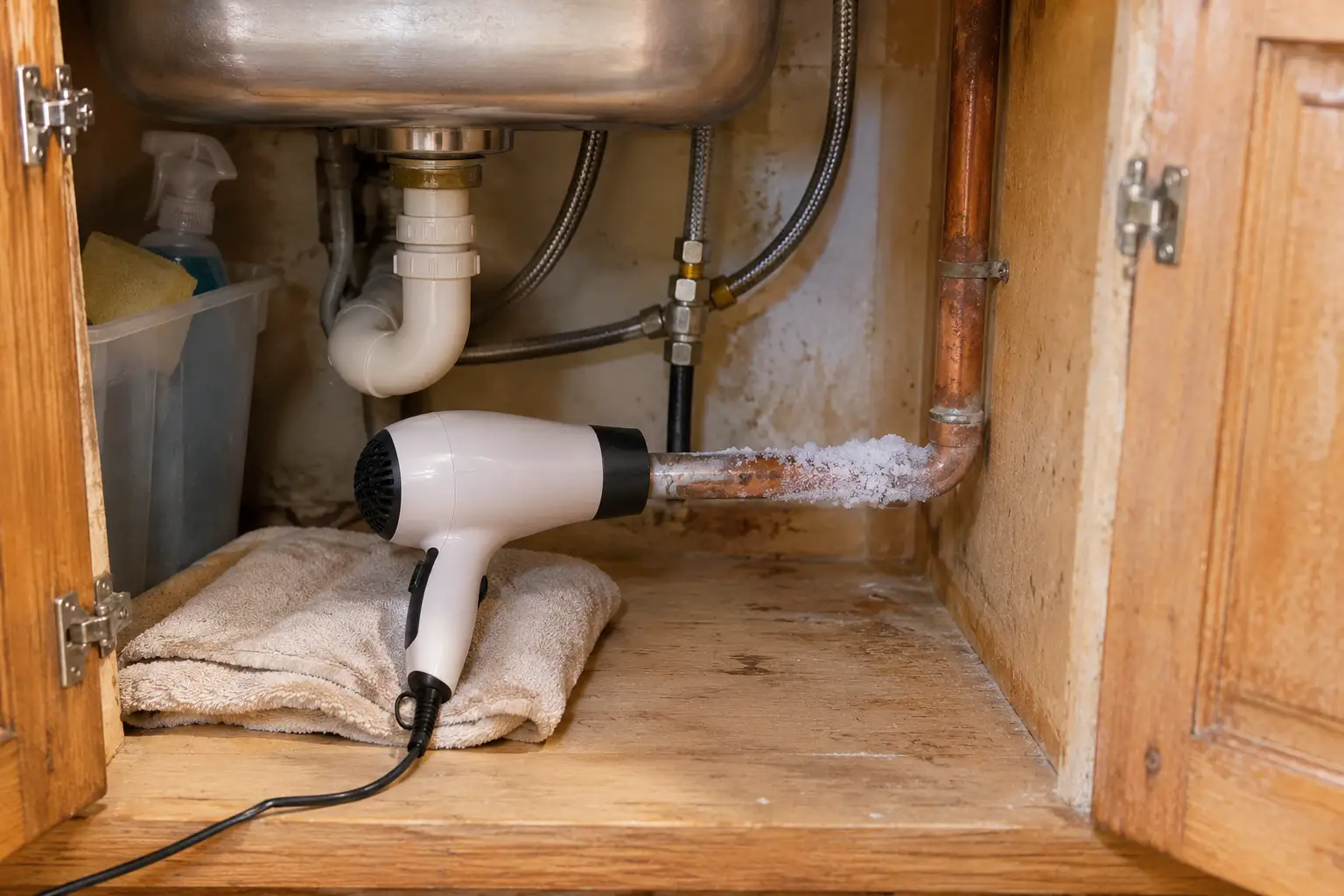
You turn on the kitchen tap on a bitter morning and get a trickle, or nothing at all. That usually means ice in the line. Learning how to thaw a frozen pipe the right way can save the pipe, while the wrong method can crack it or start a fire. This guide covers finding the ice, warming it slowly and spotting the signs that the line has already split.
The short answer
Open the faucet the frozen line feeds. Warm the pipe from the faucet end back toward the ice with a hair dryer, a heating pad or warm towels. Keep going until full flow returns. Never use an open flame. If you see a crack, a bulge or water, close the main valve and call us.
First, confirm the pipe is frozen
Not every weak faucet is an ice problem. Before you start warming anything, rule out the simple causes.
- The temperature outside dropped well below freezing overnight.
- Only one or two faucets are affected, while others in the house run normally.
- The weak faucet sits on an outside wall, over a garage or near a crawl space.
- You can see frost on an exposed pipe, or it feels much colder than the pipes around it.
- Toilets on that branch refill slowly or not at all.
If every faucet in the house is dry at once, the freeze may be at the main line where it enters the house, or the issue may be outside the home entirely. That calls for a technician rather than a hair dryer.
Find the frozen spot
Ice usually forms where a pipe passes through the coldest part of the house. Trace the line from the faucet that stopped working back toward where it comes from, and look in these places.
On exposed pipe, frost or a slight bulge marks the spot. Inside a wall, the frozen section is often right behind the coldest patch of drywall. Feel along the wall with your hand.
How to thaw a frozen pipe step by step
Open the faucet
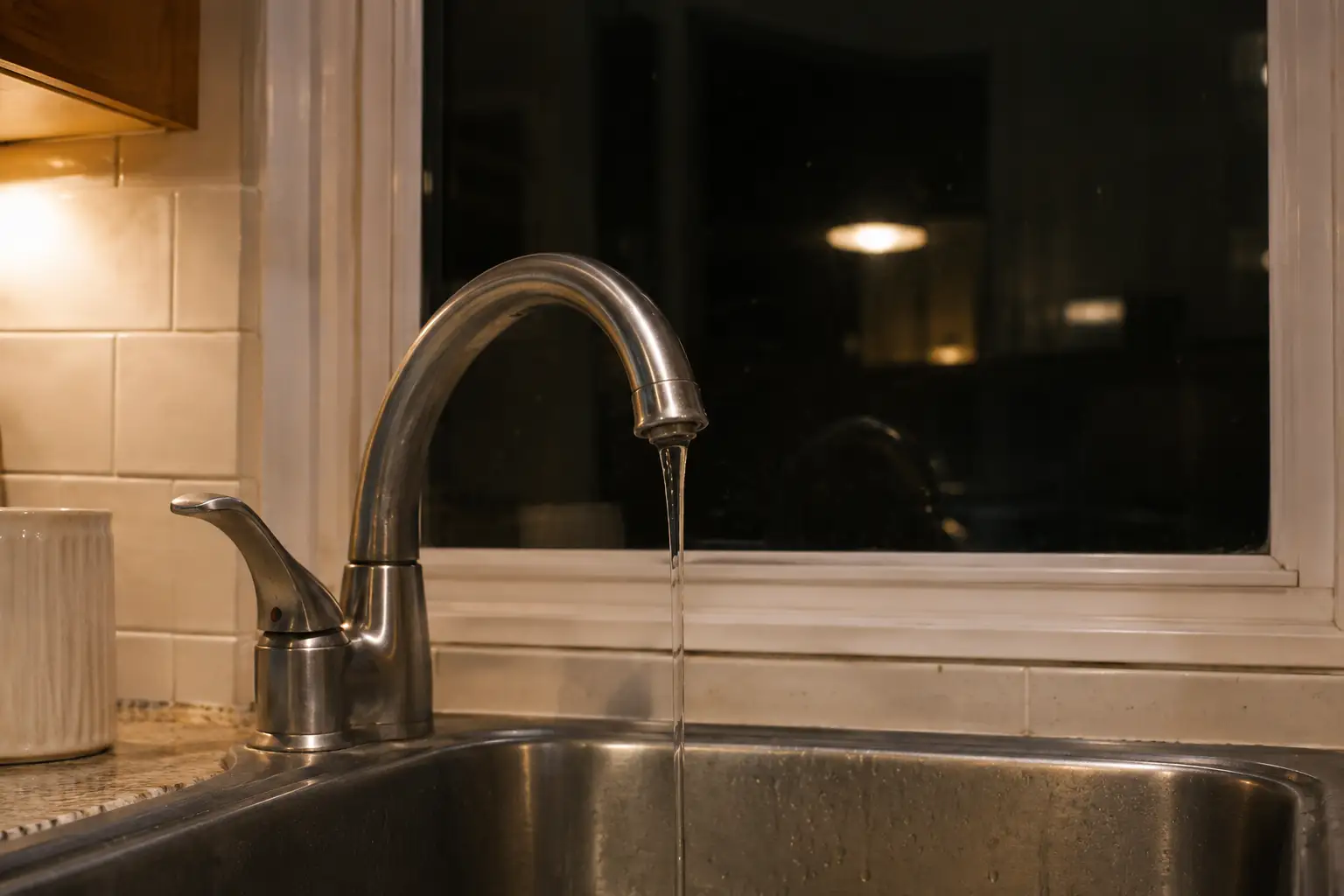
Turn on both hot and cold at the affected faucet. Moving water melts ice faster, and an open faucet gives melted water and built up pressure somewhere to go.
Start near the faucet
Warm the pipe closest to the faucet first and work back toward the frozen spot. That way melted water can always drain out rather than getting trapped behind the ice.
Use gentle, steady heat
A hair dryer moved back and forth, an electric heating pad wrapped around the pipe, or towels soaked in hot water all work. It takes patience, often thirty minutes or more.
Warm the space, not just the pipe
Open cabinet doors so room air can reach the line. A space heater can warm a cold room, as long as it sits on a hard floor well clear of anything that can burn.
Keep heating until full pressure returns
A trickle is a good sign but not the finish line. Keep going until the faucet runs at normal strength, then check the whole run for drips.
Heat sources compared
| Heat source | Safe to use? | Notes |
|---|---|---|
| Hair dryer | Yes | Keep it moving and away from standing water. Plug it into a dry outlet. |
| Heating pad | Yes | Wrap it around the pipe and check the skin of the pipe every few minutes. |
| Hot wet towels | Yes | Slow but very gentle. Swap them out as they cool. |
| Space heater | With care | Hard floor, three feet of clear space, never left alone in a closed cabinet or crawl space. |
| Torch, lighter or candle | Never | Can scorch framing, melt PEX and PVC, and turn water inside the pipe to steam that bursts it. |
| Kerosene or propane heater | Never | A fire and carbon monoxide risk in a small space. |
Never use an open flame
Every winter, house fires start from someone thawing a pipe with a torch. Wood framing and insulation inside a wall can smolder unseen for a long time. Gentle heat is slower, and it is the only safe choice.
Signs the pipe has already split
Water expands as it freezes, and the pressure has to go somewhere. Copper can split along its length, PEX can swell at fittings, and older galvanized steel can crack at a joint. Often the damage only shows once the ice melts.
- A visible crack, bulge or bubble in the pipe
- Water dripping, spraying or soaking through drywall as the line warms
- A hissing sound inside the wall
- The water meter moving with every faucet closed
If you see any of these, close the main valve right away. The guide on what to do when a pipe bursts covers the next steps.
When to stop and call us
Thawing a frozen pipe yourself makes sense when the ice is in a pipe you can see and reach. Call Plumber Cheyenne instead when any of these apply.
Call for help
- The frozen section is inside a wall, ceiling or floor
- No water anywhere in the house
- You see a crack, bulge or leak
- An hour of gentle heat has not brought any flow back
- The line runs through a crawl space you cannot safely reach
Usually fine to handle yourself
- A single exposed line under a sink
- Water is still trickling through
- The pipe looks and feels intact
- You can keep the area warm while you work
A technician can find the ice, thaw it with proper equipment and repair any split. Read about frozen pipe repair to see what the visit covers. You hear what is involved before anything starts.
Stop it from freezing again
A pipe that froze once will freeze again at the next cold snap unless something changes. Cheyenne winters bring hard freezes and strong wind, so a line that froze in December is very likely to freeze in January too.
- Insulate the exposed section with foam pipe sleeves.
- Leave cabinet doors open on outside walls when temperatures drop.
- Let that faucet drip slowly during the coldest nights.
- Seal drafts where the pipe passes through a wall or rim joist.
The full checklist is in how to keep pipes from freezing.
Questions people in Cheyenne ask
How long does it take to thaw a frozen pipe?
It depends on how much ice there is and how cold the space is. A short frozen section under a sink often clears in thirty to sixty minutes with a hair dryer. A longer run in a crawl space or wall can take much longer, and that is when a technician helps.
Will a frozen pipe thaw on its own?
It will once the air around it warms up, but that can take days in a cold crawl space. Waiting also gives a hidden split time to cause damage when the ice finally melts. Warming it under your watch is the safer path.
Should I leave the faucet open while thawing?
Yes. An open faucet lets melted water flow out and relieves pressure between the ice and the faucet. Flowing water also helps melt the rest of the ice faster. Open both hot and cold.
Can I use a heat gun on a frozen pipe?
A heat gun gets hot enough to scorch wood, melt PEX and plastic fittings, and damage solder joints. A hair dryer is the safer tool. If you do not have one, a heating pad or hot towels will also work.
How do I know if a frozen pipe burst?
Look for a crack or bulge in the pipe, water appearing as the line thaws, wet drywall or a hissing sound inside a wall. If the water meter keeps moving with every faucet closed, water is escaping somewhere.
Is it safe to use a space heater near pipes?
It can be, with care. Set it on a hard, level floor with plenty of clear space, keep it away from boxes, insulation and curtains, and never leave it running unattended in a cabinet or crawl space.